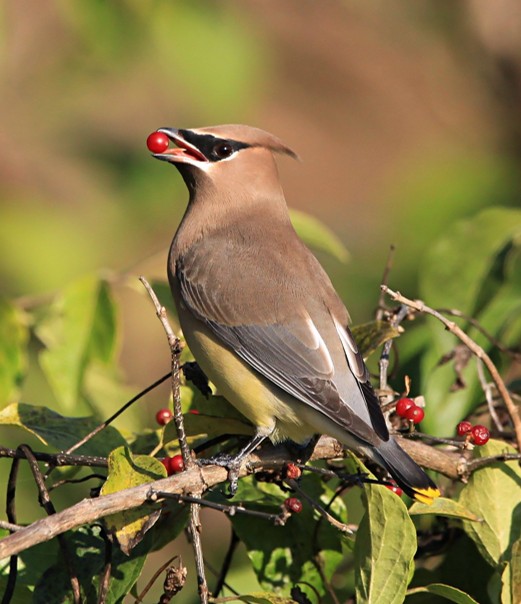
A Cedar Waxwing at my window becomes a personal reckoning with invisible glass, unintended design, and how modest, practical changes at home can spare countless birds unnecessary deaths.
Do Cardinals Know They Are Red? A Closer Look at a Christmas Icon
This article explores how cardinals perceive their environment, and how they explore their place in it, especially with respect to color.
The Club-Winged Manakin: A Bird That Plays Its Wings
The club-winged manakin, a small South American bird, produces unique wing-generated sounds for courtship, trading flight efficiency for the ability to attract females with precise stridulation.
The Green Thing We Forgot: Living Lighter on a Crowded Earth
The story goes like this: a young cashier gently suggests to an older woman that she bring her own grocery bags next time because plastic is bad for the planet. The woman smiles and says, “We didn’t have the green thing in my day.” Then she begins listing everything her generation did before “sustainability” became... Continue Reading →
Yesterday’s Tomorrows: How Early Books Reveal the Future of Science
The Linda Hall Library houses a remarkable History of Science collection, showcasing pivotal works like Gart der Gesundheit, Mundus Subterraneus, and Micrographia. These texts not only reflect the scientific knowledge of their times but also laid foundational concepts that influence modern science, illustrating the evolving relationship between evidence, imagination, and inquiry.
Keep Young and Beautiful: A Natural History of Courtship, Vanity, and the Art of Looking Good
Annie Lennox's song "Keep Young and Beautiful" reflects the irony of beauty as a persuasion strategy rooted in evolutionary biology. Various species, from cleaner wrasses to dung beetles, demonstrate deliberate manipulation of appearance and behavior to enhance mating success, revealing shared evolutionary patterns in beauty and attraction across species.
Cognitive Showdown: Crows vs. Toddlers in the Science of Intelligence
Corvids, particularly crows and magpies, exhibit cognitive abilities comparable to human toddlers, including tool use, self-recognition, and social inference. Their intelligence prompts reconsideration of evolutionary assumptions about cognition. Recognizing these advanced mental processes highlights the need for conservation efforts to protect these remarkable birds amidst human threats to their habitats.
Dracula, Vlad the Impaler, and the Science of Fear
The Legend and the Man Vlad the Impaler dining amongst his victims. German, published posthumously (1499), twenty-two years after his death. Vlad III, known as Vlad the Impaler (1448-1477), has long been entangled with the legend of Count Dracula. Bram Stoker’s vampire borrows his name and homeland, but the real Vlad was no immortal creature... Continue Reading →
The Physics of Santa’s Sleigh: How Science Could Get Him Airborne
Every December, Santa Claus faces the challenge of delivering presents worldwide. By integrating modern technologies such as jet and ion propulsion, graphene wings, and bioengineering for reindeer, his sleigh could potentially take flight. However, significant breakthroughs in quantum mechanics and materials science are essential for this fantasy to become reality.
Are Octopuses Aliens? Debunking Extraterrestrial Theories
In a recent blog post, I explored the intriguing hypothesis that octopus intelligence may have extraterrestrial origins, as proposed by a global team of researchers, as part of the Astrobiology section of the upcoming Life Beyond Earth? exhibition at the Linda Hall Library. The idea was tantalizing—a species so vastly different from anything else on... Continue Reading →