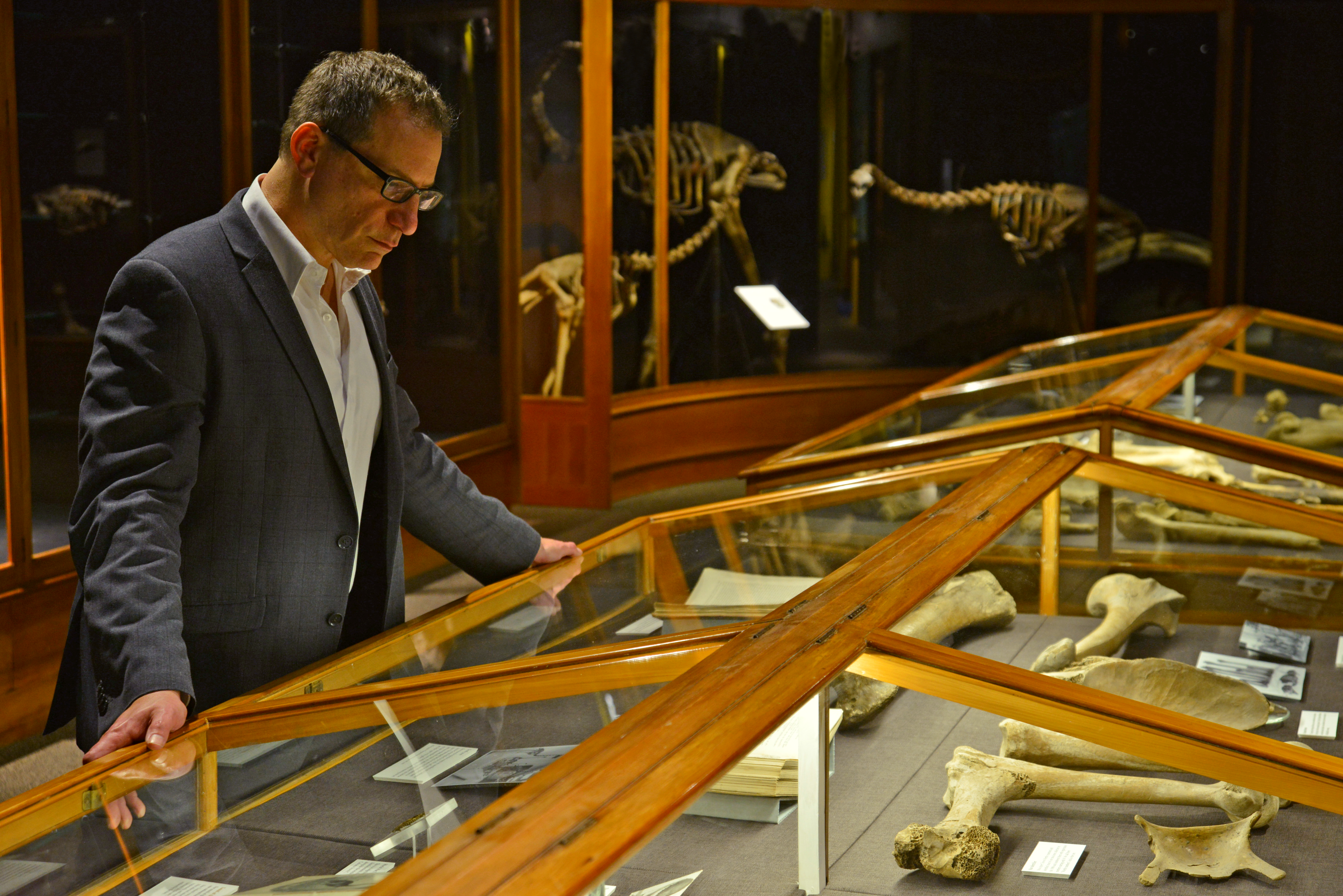
The collecting institution sector has always been fascinating to me, and I feel fortunate to be a part it. A thread through my various activities is finding solutions to the exploration of knowledge.
Culture.
It’s a privilege to be in my fourth year as President and CEO of the Linda Hall Science Library and Arboretum, in Kansas City, MO. The Library’s holdings of over two million books, including works going back to 1472, make it one of the most prestigious independent science institutions in the United States. Founded in 1946, the Library sits on the former estate of its founders the Hall family, the grounds of which are now a scenic Arboretum. Additionally, I’m an adjunct at the University of Missouri Kansas City in the School of Humanities and Social Sciences, contributing to research on human-nature interactions.
Before this, I’ve been in both academic and museum settings, including leading Pittsburgh’s Carnegie Museum of Natural History and the North Carolina Museum of Natural Sciences. My first leadership role was as the Director of Whanganui Regional Museum in New Zealand. Cultural leadership roles has given my an opportunity to connect the power of collections to engagement with, and advancement of, science and culture. As a result, building collections with purpose has been a consistent theme across my career.
One of the most satisfying aspects of my history has been the development and mounting of exhibitions. Whether it was leading development of New Zealand’s first permanent gallery on Moa, America’s first major exhibition on the Anthropocene, or re-enlivening a diorama gallery at the Carnegie, curating historical exhibitions at the Linda Hall, or developing a full-scale walk-through scientific murder mystery at the Museum of New Zealand / Te Papa Tongarewa, I have always found that exhibitions are a consistent way to unlock curiosity and create an accessible dialog with scholarship.
Internationally, I continue to work in the sector, most recently serving as an executive board member of the International Council of Museums (ICOM) and for nine years served as chair of ICOM’s International Committee for Museums and Collections of Natural History (NATHIST), as well as deputy chair of the international ethics committee (ETHCOM).
Knowledge.
Writing has been consistently important through my career. For all the different kinds of writing I do, exhibition labels, articles, my blog, and books, including The Future of Natural History Museums (Routledge, 2018), it’s popular science that brings me the most joy, and is something I return to frequently. This is the place that enables me to translate the scientific principles I have spent years grappling with into something creative that a non-scientific reader can feel as well as understand. My most recent publication is as co-author of the beautiful The Linda Hall: A Visual History (Linda Hall Press, 2026).
Recently I started The Attentive Naturalist on Substack, which is a place for longer essays that look more closely at both the natural world and the human one, often through the same lens. I write about ecology, animal behavior, Egyptian animal mummies, dioramas, the history of science, and whatever else seems to form connective tissue between the natural world and the social one.
Nature.
From a scientific perspective, an idea that has occupied me longest is how ecological patterns that make sense at one level, a single bird’s foraging choice, a stand of trees, a wetland’s water chemistry, can produce entirely different outcomes at the level of a landscape or a region. My research on waterbirds in human-dominated environments, sustained on and off for twenty years across institutions and coastlines, has traced this question through reef systems increasingly shaped by development and tourism. Some of my scholarly papers have made it to Research Gate.
Involving the public in conservation science is, for me, especially meaningful. Aside from collecting robust data, these initiatives embed natural heritage more deeply in our culture through first-hand experiences. I have been fortunate to be able to create community science opportunities with some of my work. These include guiding the foundation of the Birds in Backyards project in Sydney, Australia, as well as New Zealand’s Kererū Discovery Project.
The Linda Hall Arboretum has given me a new, complementary vantage point, an urban landscape where the same questions about scale play out among trees, soil, and the people who walk through it every day. At the Linda Hall, we are tracking each of the trees in real time, as well as moving toward opening a herbarium with a founding collection of 40,000 specimens going back more than a century. When fully online, these collections will allow us to contribute to studies of heat islands, urban biodiversity, and the use of green spaces in cities. Both the herbarium and arboretum are already giving community scientists opportunities to contribute meaningfully to this work.

