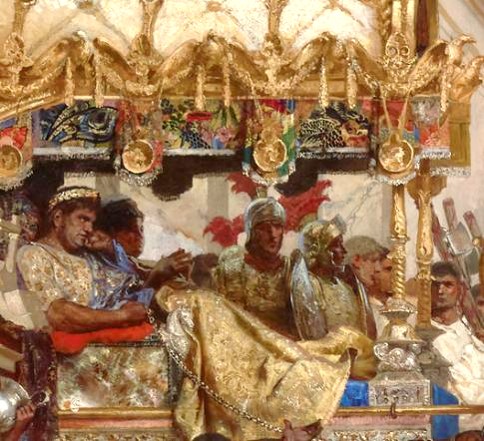
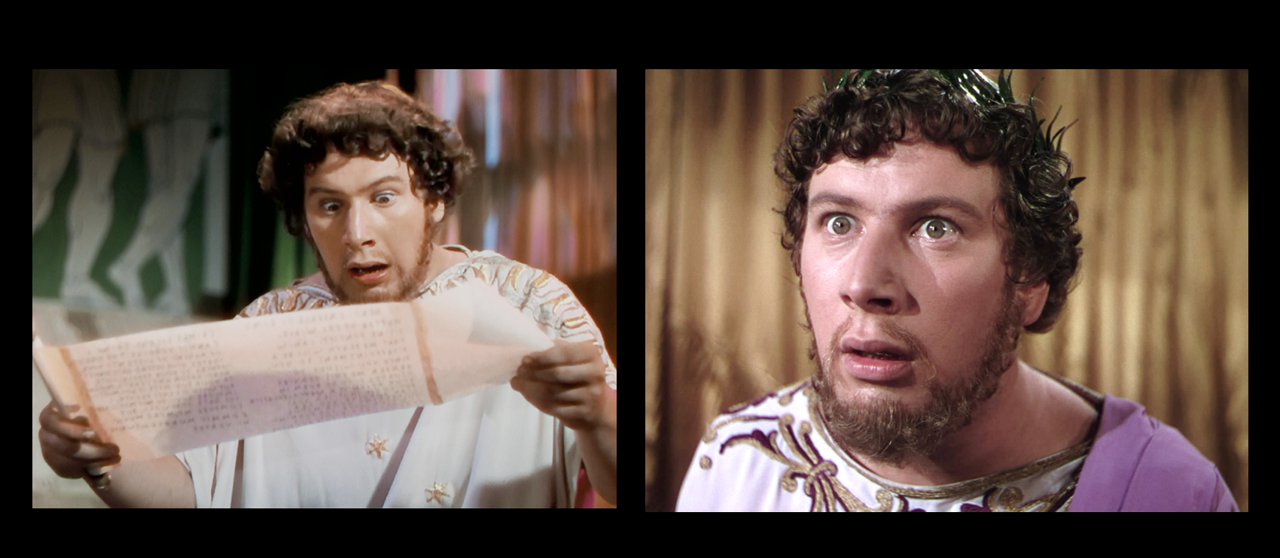
In preparation for writing this post, I’ve just finished my first-ever viewing of the 1951 Hollywood Classic “Quo Vadis.” Sure, it’s got the dashing Robert Taylor, and Deborah Kerr playing a calm and understated Lygia, the displaced princess turned Christian believer. But the real star of the film is Peter Ustinov, as a delightfully deranged, insecure, and neurotic Nero. It made his career and brought the MGM a desperately needed win for this lavish three-hour epic.
In my earlier Bad Leaders posts, I have written about Caligula, Vlad the Impaler, Henry VIII, and Ivan the Terrible. Each represents a different flavor of bad leadership. Caligula may have had medical challenges. Vlad ruled through a calculated deployment of terror. Henry was governed by his appetites and Ivan, his paranoia. Nero belongs in this company, presenting a case study in what happens when a system designed to produce accountability is deliberately, patiently, and successfully dismantled from within.
In some ways, he is also the most psychologically instructive of the group, because his pathology was not rooted in trauma, organic illness, or an environment of existential threat. Instead, Nero was assembled by his circumstances, crafted by people who believed (falsely as it turned out) that they could control what they were creating.
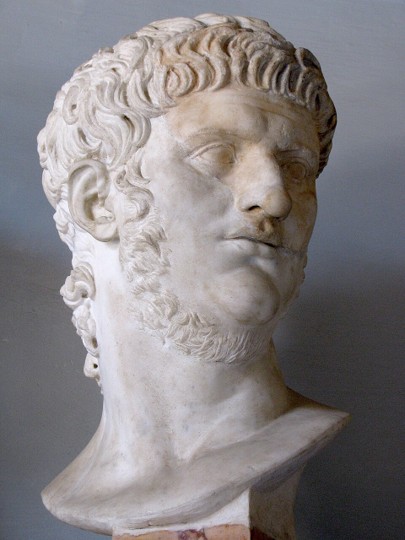
What Made Nero
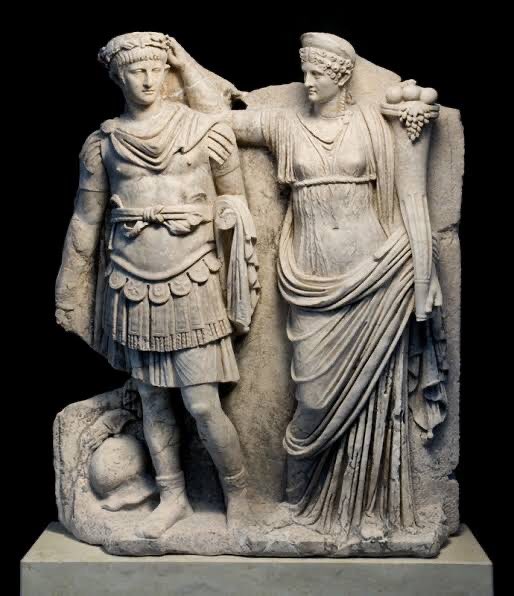
Lucius Domitius Ahenobarbus was born in 37 CE into the Julio-Claudian dynasty, a family so comprehensively dysfunctional that it reads less like a ruling house and more like a longitudinal study in heritable narcissism. His father, by ancient accounts, was brutal and dissolute. His mother, Agrippina the Younger, was one of the most formidably intelligent and amoral operators in Roman history. She had him renamed Nero, maneuvered him into the succession ahead of Claudius’s biological son Britannicus, and married Claudius herself to secure the path. When Claudius died in 54 CE, the circumstances were suspicious enough that ancient sources named Agrippina as the likely poisoner. Nero, aged sixteen, became emperor. (For a deeper dive, see BBC’s excellent 1970s series I, Claudius based on the novels by Robert Graves.)
Nero was installed into it by a woman who expected to govern through him. That expectation proved catastrophically mistaken, and the miscalculation is itself a lesson. Agrippina the Younger assumed that a child she had shaped entirely could be managed indefinitely. When he ultimately did away with her, she had not accounted for what happens when the child is also a narcissist who eventually acquires the means to manufacture his own reality.
The clinical profile that emerges from ancient sources is consistent enough to be taken seriously. Suetonius, Tacitus, and Cassius Dio describe a man defined by grandiosity, an inability to tolerate criticism, a complete absence of empathy toward those he found useful, and an extraordinary capacity for self-dramatization. He believed himself a great artist, a divine performer, a figure whose talents had been obscured by the unworthy demands of governance. That last conviction is significant. Most tyrants, even the worst ones, believe they are governing. Nero appears to have believed that governance was an interruption.
Neuroscience of the Untouchable
Modern psychology offers a useful framework here, though it requires careful handling. Diagnosing historical figures is always speculative; the sources are filtered through political hostility, literary convention, and the priorities of men writing decades after the fact. What we can say is that the behavioral pattern attributed to Nero aligns closely with Narcissistic Personality Disorder (NDP) as currently defined, and that the environmental conditions of his childhood and adolescence are precisely those identified in contemporary research as predisposing individuals toward that cluster.
A Harvard study, published in Memory (2024) by Finch, Kalinowski, Hooley, and Schacter, provided the first empirical evidence that grandiose narcissism shapes how people imagine the future, as well as remembering the past. People scoring higher in grandiosity recall positive past events with greater vividness and ease than negative ones, and this same bias extends to anticipating future situations. They imagine positive futures more vividly, think about them more frequently, and judge them as significantly more plausible than negative outcomes. This sounds like a nice trait to have, especially if you’re an emperor, but the mechanism is self-reinforcing: the more often a grandiose individual simulates a flattering future, the more inevitable it comes to feel. Thinking about Nero, the dissociation between inner conviction and external reality that has obvious implications for a man who declared his Olympic victories legitimate and his artistic gifts unrecognized by an unworthy world.
Research on narcissism and power has established a feedback loop that is now reasonably well understood. Power reduces perspective and increases risk tolerance. It attenuates the social monitoring that normally moderates behavior. In individuals with preexisting narcissistic organization, power removes the constraints that would suppress it. What you see, once those constraints go (e.g, once Nero became and adult), is the structure that was always there.
Not unlike Caligula, Nero’s early reign was, by most accounts, capable. The philosopher Seneca and the Praetorian prefect Burrus provided structural checks, and the period from 54 to 59 CE is sometimes called the quinquennium Neronis, the five good years. Once Burrus died and Seneca was pushed aside, the architecture that had been moderating Nero’s behavior collapsed. The good years were not evidence of a different Nero, but of a Nero who had not yet found a way to remove the people limiting him.
The Performance of Power

What distinguishes Nero from the others in this series is the aesthetic dimension of his narcissism. He was obsessed with performance, literally and structurally. (It’s hard not to think of Louis XIV, the “Sun King”.) Nero appeared onstage as a singer and lyre player, acts considered deeply degrading for a Roman emperor, and required audiences to applaud on cue. He competed in the Olympic Games, won every event he entered (hardly a surprise), and declared the victories legitimate. He constructed the Domus Aurea, the Golden House, an extraordinary palace complex that consumed a substantial portion of Rome’s urban center and included a colossal bronze statue of himself as the sun god, over thirty meters tall.
This was a coherent expression of his particular psychological structure. The grandiose narcissist does not merely want power; he wants the world arranged as confirmation of his own specialness. When reality declines to cooperate, reality must be adjusted. The performances were compulsory because voluntary applause would have introduced the possibility of a different judgment. The Golden House was built on the ruins of the Neronian fire, whether or not Nero set that fire deliberately, because catastrophe created the space his vision required. The logic is consistent throughout. (See an interesting analysis of his psychology here: Walker, Cayce, “The Reign of Nero: A Delusional Journey to Suicide” (2020). Student Research Submissions. 336. https://scholar.umw.edu/student_research/336 .)
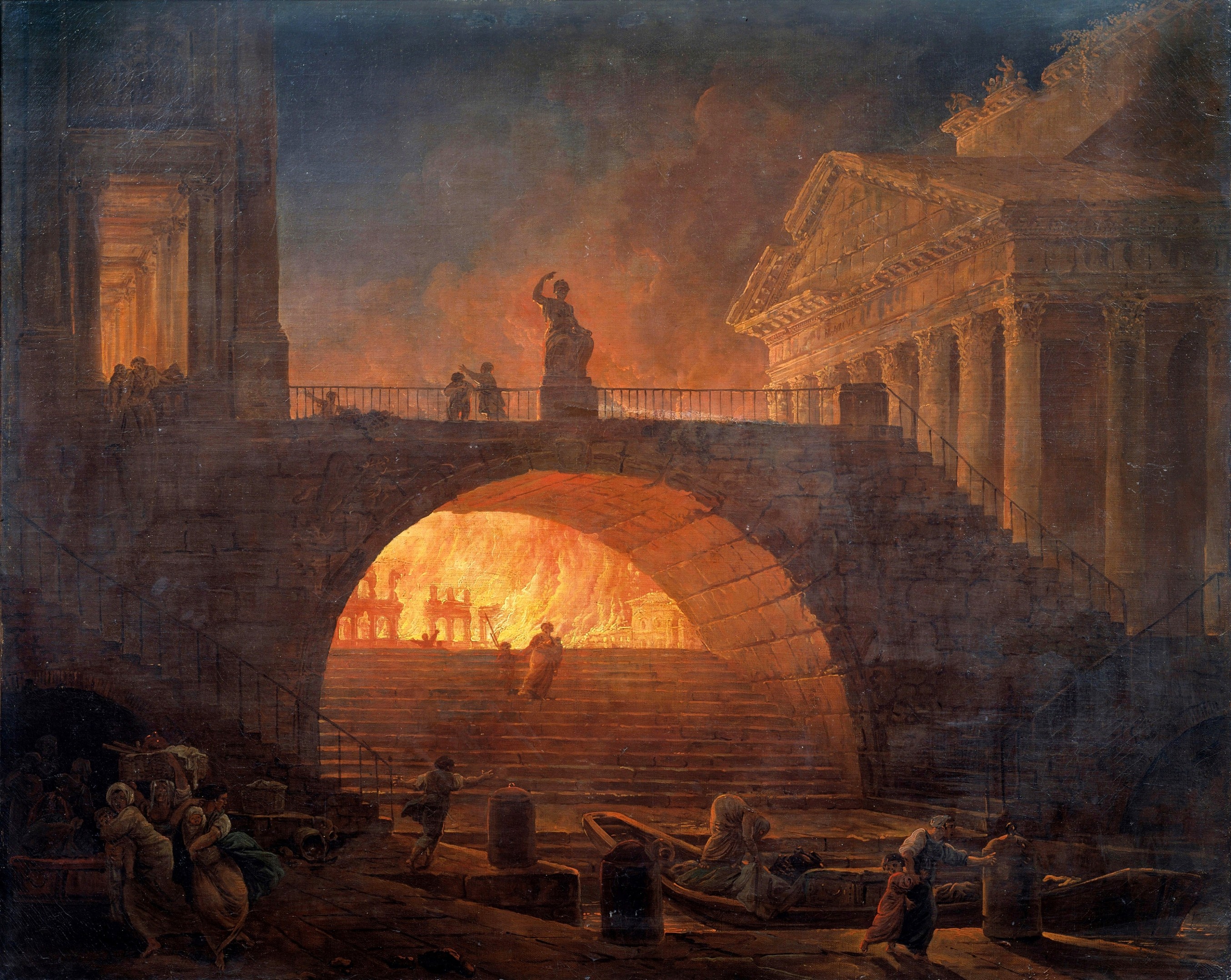
The Neronian fire of 64 CE is historically contested. No credible ancient source definitively establishes Nero’s culpability, and several scholars argue that the distribution of the fire’s origin points away from deliberate ignition. What is clear, though, is that Nero was at Antium when it started, returned to the city, and then used the destruction to build on a scale otherwise impossible within Rome’s existing urban fabric. He also redirected suspicion onto the Christians, initiating what became a significant persecution. Whether his hand was directly involved or not, the instrumentalization of catastrophe is fully consistent with his psychology.
When the System Has No Floor
Rome’s republican institutions had been progressively hollowed out across the Julio-Claudian period and, by Nero’s reign, the Senate’s authority was primarily ceremonial. The checks that had originally structured Roman governance were, by 54 CE largely gone, to be replaced by personal loyalty and fear, distilled to the judgment of one man. Seneca and Burrus were merely individuals with influence and the capacity to persuade. When they were ultimately gone, there was no institutional structure to replace them.
Modern organizational psychology calls this phenomenon structural narcissism, the tendency of organizations built around a single unchecked authority to begin reflecting the pathology of that authority outward. Decisions become less about outcomes and more about loyalty performance. Information that might challenge the leader’s self-image is filtered before it arrives. The feedback loop that keeps any system responsive to reality is severed, and the system begins to optimize for the leader’s comfort rather than its own effectiveness.
Under Nero, Roman governance continued to disintegrate rapidly. Senators were executed for insufficient enthusiasm. Generals who won significant victories were recalled, because their success created a rival narrative. Nero’s mother Agrippina, who had built him, was murdered on his order in 59 CE after she became an obstacle to his relationship with Poppaea Sabina. His first wife Octavia was exiled and then killed. His second wife Poppaea died in mysterious circumstances, to be replaced (as Empress) by a slave boy named Sporus because he looked remarkably like Poppaea. Interestingly, Sporus overlapped with Nero’s third and final wife, Statilia Messalina (permanently removing her previous husband in the process).
The Corruption That Was Already There
Let’s face it, the bar for acceptable imperial behavior was not high. Roman emperors routinely murdered rivals, executed senators, and maintained power through terror. What made Nero exceptional within even that context was the completeness of his self-reference. He was not violent in the service of strategic goals, as Caesar Augustus had been; Augustus’s cruelties were largely calculated, aimed at securing a specific political architecture. Nero’s violence was expressive, expressing what he wanted, what offended him, what disrupted his self-conception. The empire existed to service a single psychology, and when that psychology deteriorated, the empire deteriorated with it.
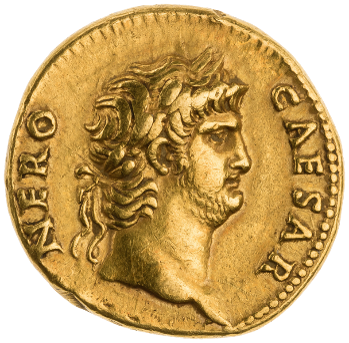
By the end of his reign, Nero had exhausted the treasury on his own projects, debased the coinage, and watched successive revolts erupt across the provinces. When the end came in 68 CE, it came quickly. The Senate declared him a public enemy, the legions turned, and Nero fled Rome with a handful of freedmen. He died by suicide at thirty, reportedly uttering Qualis artifex pereo (‘What an artist the world is losing’). The self-conception was intact to the last.
Lessons from Nero
Each figure in this series so far has illuminated something distinct about the failure of unchecked authority. Vlad shows us terror weaponized into policy. Henry shows us appetite dressed as sovereignty. Ivan shows us fear consuming the very security it sought to create. The lessons from Nero feel a bit more disturbing: what power looks like when it is captured entirely by a self perception in a political system that provides no checks on behavior.
The clinical literature on narcissistic leadership converges on the problem is never being just about the individual. Narcissistic leaders require systems that have been sufficiently weakened to accommodate them. Agrippina , the Senate, even Seneca and Burrus (whatever their virtues) operated as personal moderators rather than institutional checks, and personal moderators are always contingent. And to demonstrate that Nero (whatever his faults) wasn’t an aberrant loner, you only need to look at the powerfully unsuccessful reign of Emperor Commodus, about 130 years later. Definitely not the same personality as played by Joaquin Phoenix in The Gladiator.
That is the structural lesson Nero offers. Pathology at the top is rarely the first failure. It is usually the last symptom of a system that stopped holding itself accountable long before any particular bad actor arrived to exploit the gap. Rome did not produce Nero. Rome produced the conditions in which a Nero could persist for fourteen years, and that is a different, and far more uncomfortable, finding entirely.


Leave a Reply