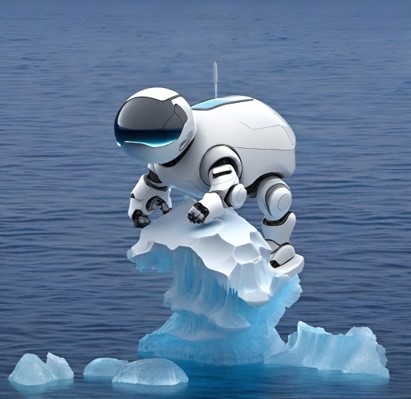

Artificial Intelligence (AI) and climate change are two of the hottest button issues facing society today. While both have far-reaching implications for our lives and well-being, it’s intriguing that while both are generating a significant buzz, AI is surpassing climate issues in generating fear of being an existential threat to humanity. People are busy enjoying the benefits of AI (all of the images in today’s post were generated by the app “Wonder”), despite the growing concern. Climate change remains a polemic debate in which many (in the US at least) are either passively disinterested or completely reject it (46% of Americans, in fact, despite 2023 being the hottest northern hemisphere summer on record). Meanwhile, 61% of Americans believe that AI is a major threat to the future of humanity. I recently read an excellent interview with Douglas Hofstadter, Pulitzer winning author of Gödel, Escher and Bach expressing AI as looming catastrophe for humanity. To me, many of the arguments could – and do – also apply to the climate crisis.
In this post, I‘ll explore what seems like a paradox. Why do people seem more worried by AI than climate change, even though both issues demand our urgent attention?

Familiarity
AI, in various forms, is already a part of our daily lives. From virtual assistants like Siri and Alexa to recommendation algorithms on streaming platforms, we interact with AI regularly and increasingly expect to the ability curate every experience we have, from the media we watch to the vacations we take. It’s already in our homes, in our pockets, and around our wrists. It can scan us in our sleep to monitor our health. Despite, this level of implicit trust, the level of intimacy with us and our loved ones amplifies any perceived threat. The list of potential effects on our lives is growing ominously, from privacy concerns, to job displacement, to something far more sinister (like nano-bots in our bloodstream, for instance). Now, I’ll admit here, I’m not aware of any anti-AI demonstration on the scale of global calls for climate action (although that’s coming apparently). By contrast, despite the palpable effects of dying lawns, groaning AC units, or the disturbing news on our Instagram feed of the catastrophic failure of the 2023 cohort of Emperor Penguins, climate somehow remains a remote abstraction.
Media Coverage and Pop Culture
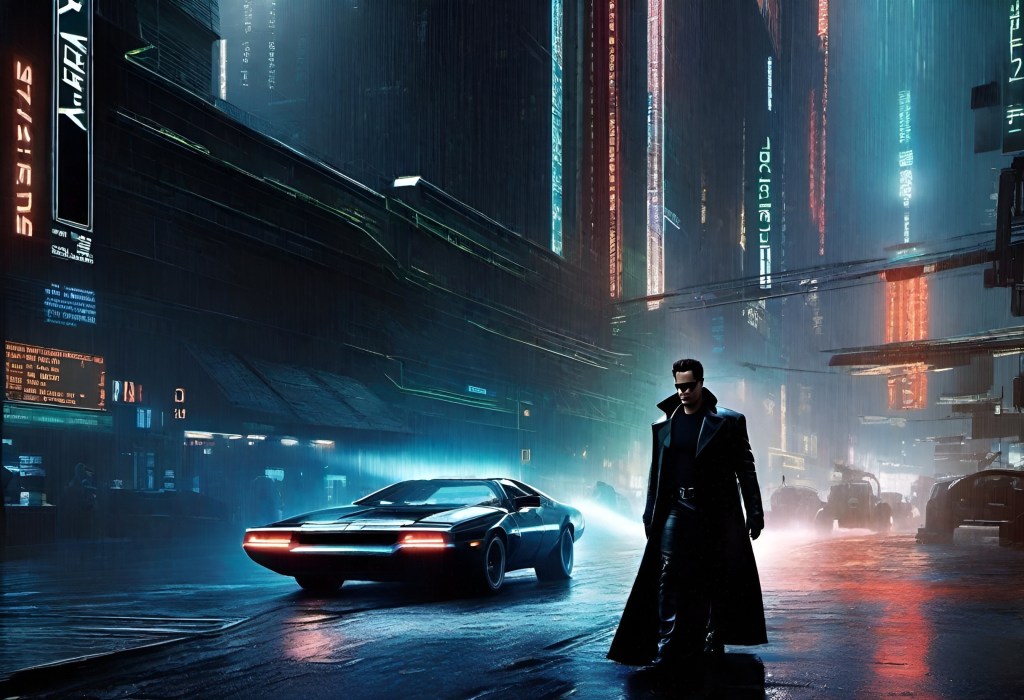
Media always plays a significant role in shaping public perception. The coverage AI is receiving is skyrocketing in news articles, podcasts, and documentaries. Most of what comes to my feed is how to make money with AI hard on the heels of intellectual concerns over its consequences. Adding to this have been decades of science fiction films (The Terminator, West World, Blade Runner, The Matrix, going back to the 1957 film Desk Set with Katharine Hepburn and Spencer Tracy) that depict effects of AI as ranging from making humans irrelevant to being malevolent overlords forcing us to live in a dystopian society of their own creation. Many of these images have entered our social consciousness. At least two generations of youngsters grew up saying “I’ll be back” in a bad Austrian accent. These portrayals can reinforce the fear of AI, as they depict a future where machines turn against their creators. Climate change, although extensively covered, doesn’t have this single focal point. There’s no rampaging cyborg with glowing red eyes. No Abdul the Snake Maker (points if you know where he’s from). Without that nemesis to fight, climate change simply can’t capture the same level of imagination.

Perceived Control
Human beings have an inherent desire for control and the ability to influence their environment. Climate change discussions often include mitigation strategies that focus on personal actions, providing a sense of agency and control, even if the effectiveness of actions – on the scale of an individual – are somewhat debatable. By contrast, when it comes to AI, there is a sense of losing control, as decisions and outcomes are delegated to machines or humans with ill intent. See, for instance, the sobering book The Coming Wave (2023) by Mustafa Suleyman. Unsurprisingly, this loss of control can trigger distrust, fear, and anxiety.

Economic Uncertainty
Many arguments against both AI and climate change (or, in fact, its mitigation) center around economic disruption. Automation and AI-driven technologies have the potential to displace jobs across various industries. As in times past, the loss of demand for certain specialist skills can lead to economic uncertainties for some individuals. History has shown, however, that while those concerns are real for individuals, at a societal level new technologies tend to enhance not detract from job opportunities.
Far more concerning, however, is the potential for bad actors to use the power of AI to challenge the infrastructure that forms the basis of our health and well-being. Simply the thought of hacking into our utility systems alone represents an incalculable risk. On the other hand, the economic impact of climate destabilization, while substantial in the long term, might not be as immediately felt by everyone, especially those in more privileged positions. That is, at least unless the Earth hits a hypothesized “tipping point,” in which is predicted to spiral out of control.
Possibly the biggest financial concept separating the two issues is that solving the climate crisis will take coordination of world governments and mobilization of vast resources. It’s often been said that as much global effort is needed as was expended in WWII. There’s nothing obvious (at least yet) that can or should be done financially to curb the risks of AI. No trees to plant. No coral reefs to put into deep freeze (yes, that’s a thing). Perhaps – and I’m no economist – simply the lack of a major economic barrier to solving the issue AI makes it easier to achieve a meeting of minds.

What does it all mean?
The experts in AI are concerned. Should I be? I’m not sure. I made it through Y2K unscathed. So far, I’ve played with some of the platforms and they don’t seem nearly sophisticated enough to achieve global domination. They can’t even tell a good joke. On the back end, AI could (from what I’m reading) be a tool for bad guys to hack our systems, turn off our utilities, and create general mayhem. But how is this just not another evolutionary step in the arms race between hackers and cybersecurity experts? I have no idea about the answer. But I’ll keep reading, as I make more AI-generated artwork for my blog post.
Meanwhile, as an ecologist, I get climate change. I inherently understand starving polar bears, or how ocean currents could come to a standstill. It comes back to familiarity.
 ERIC DORFMAN
Leave a comment