

For my last post of 2023, I’m paying tribute to one of my favorite birds: the Hoatzin (Opisthocomus hoazin). Along the verdant waterways of the Amazon, a bird that redefines the term ‘living fossil’ flaps its ungainly way through the foliage. The Hoatzin, the scruffy Goth of the avian world, is a marvel of labyrinthine evolution. It’s a bird that seems to have taken all the odd leftovers from the developmental kitchen and made a fascinating casserole. Its digestive system, for instance, is a rarely visited twig on the evolutionary tree. Unique among birds, the Hoatzin ferments vegetation in its proventriculus, a process more akin to that of a cow, the result of which leads to its less-than-complementary nickname, the ‘stinkbird.’ This digestive arrangement, termed ‘foregut fermentation,’ is a trait shared with ruminants and pseudoruminants, some rodents, some marsupials, colobine monkeys and sloths. On the brighter side, their distinctive odor (often compared to manure) might serve as a deterrent to some predators, especially humans.
Their vocalizations, consisting of a bizarre array of groans, hisses, and grunts, are as unconventional as their diet. Channeling an enraged lapdog, these sounds play a crucial role in social interactions within the group, serving as a means of communication and strengthening social bonds. Scientifically, Hoatzin vocalizations provide insight into the evolutionary development of bird calls and their role in social structuring.

An Ancestral Throwback to Dinosaurs. The Hoatzin’s real claim to fame, though, lies in its chicks. These little guys sport wing-claws, a rare trait that hearkens back to their theropod dinosaur ancestors. These claws, while reminiscent of velociraptors, serve a less menacing purpose. They aid the chicks in clambering through the branches until their wing muscles are fully developed, allowing them to be nimble in escaping from predators like hawks. As the chicks mature, the claws recede, and the wings take on their conventional bird-like form.
This is an example of the phenomenon of atavism – in which ancient, often dormant traits reappear in a species, even after millions of years. It’s a mesmerizing throwback, a genetic whisper from a bygone era. Intriguingly, the vibrant Turacos of Africa, though (probably) unrelated to the Hoatzin and currently dwelling continents apart, exhibit a similarly primitive trait. Their young also have winged claws and, in addition, they possess semi-zygodactylous feet, where the fourth toe can be rotated forward or backward (think of a parrot), a feature that echoes the versatile foot structure of early birds. Both the Hoatzin’s wing claws and the Turaco’s foot structure serve as remarkable examples of how ancient traits, once crucial for survival, can linger and resurface across the evolutionary tapestry, linking species to their distant past in a display of nature’s enduring heritage.
The idea that many dinosaurian traits remain in the avian genome has given rise to some to studies that tweak modern birds’ genomes to reveal their ancestral anatomy. Science seems to be still a long way from being able to reverse engineer a dinosaur, and brings up plenty or moral and legal issues, but it’s an intriguing thought.

A Most Unusual Lifestyle. Hoatzins live in small communal groups and their social structure is has more in common with mammals like tamarins, meerkats, and naked mole rats than most birds. In the Hoatzin breeding system, group members contribute to the care of the young, a practice known as cooperative breeding. Their social behavior has been studied on Venezuela’s central plains and there they form communal units of 2-8 individuals, typically comprising a breeding pair and up to six helpers, often their offspring from the previous year, who take part in all tasks except egg laying. Even with this assistance, nesting success is low at 27%, mainly due to predation by capuchin monkeys and toucans. Adult and young Hoatzins have high annual survival rates, so nurturing eggs and chicks is critical.
This approach to rearing young is relatively rare among birds. Only a small fraction of species, for instance the Australian mudnesters, Australo-Papuan babblers and ground hornbills, are obligately cooperative and cannot fledge young without helpers.
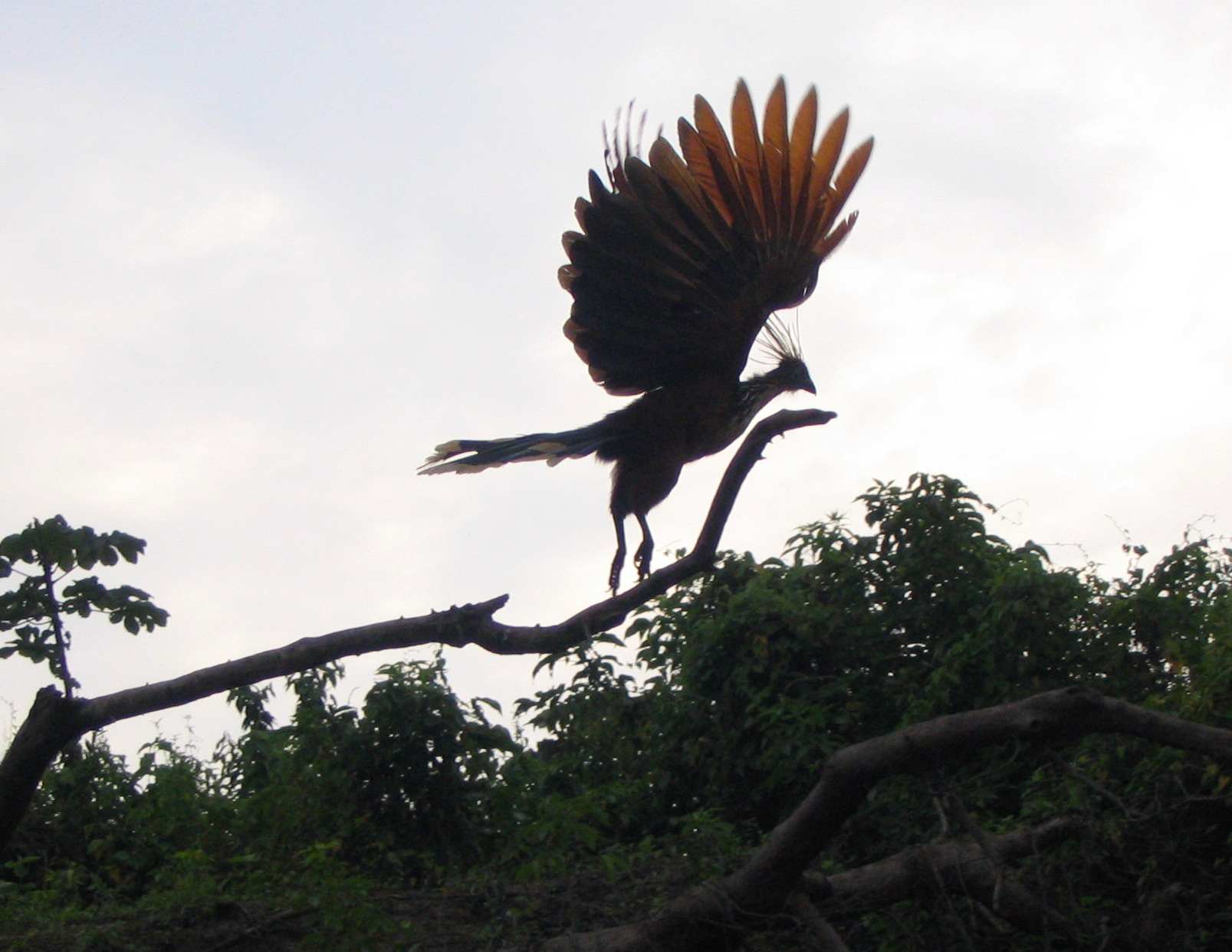
An Awkward Aerial Display. Hoatzins are not built for graceful, long-distance flights. The enlarged crop, necessary for foregut fermentation, adds significant weight to the front of the bird’s body. This additional weight alters the Hoatzin’s center of gravity, making it more front-heavy. As a result, the bird’s balance and aerodynamics during flight are affected.
As a result, their wing structure is adapted more for short, labored flights, often described as more of a frantic flapping than majestic soaring. Its wings are relatively short and broad, suited more for brief, flapping flights rather than long-distance soaring or gliding. This wing design requires more energy to achieve and maintain lift, especially given the bird’s heavier front. The energy expenditure necessary for such flight is high, making sustained flights impractical, likely explaining why their territories are small, and their whole lives are spent at or near the place where they are born.
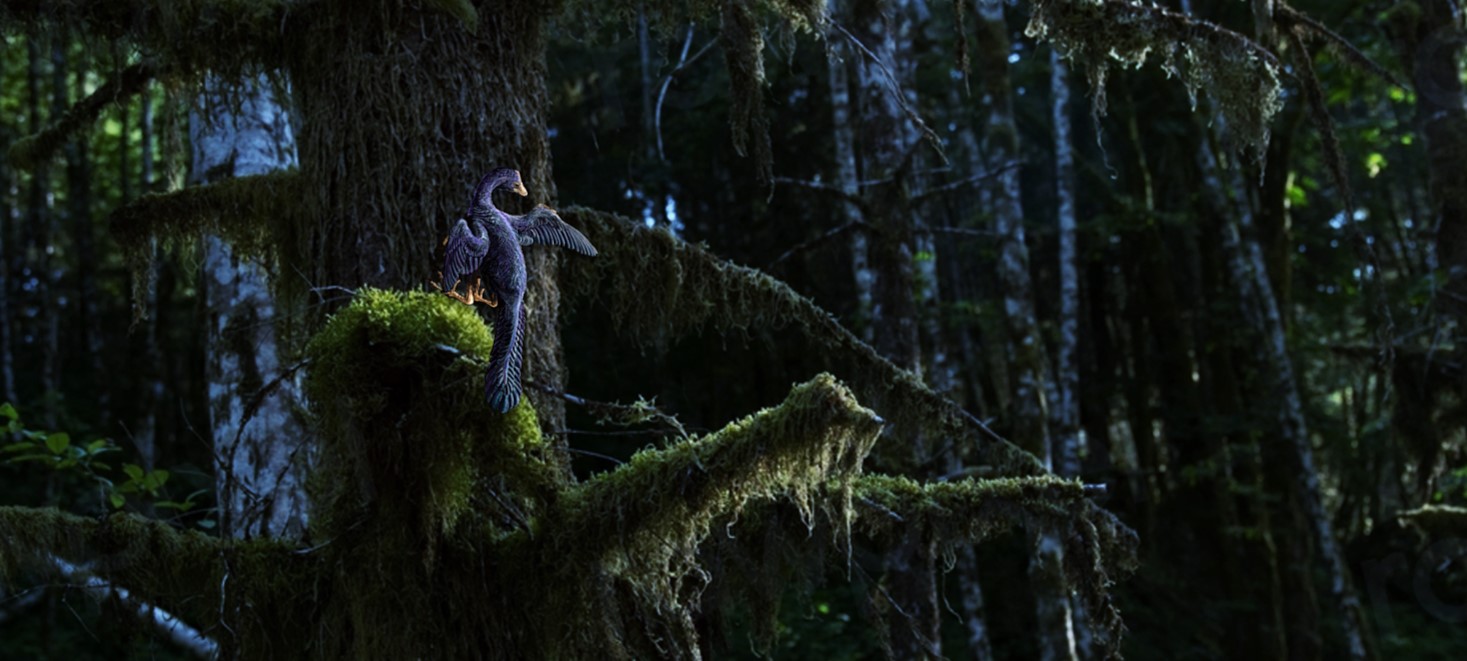
Poor Evolutionary Competitors. The Hoatzin is the last vestige of a line that branched off in its own direction 64 million years ago, shortly after the extinction of the non-avian dinosaurs. Fossils of their relatives have been found in Europe and Sub-Saharan Africa as far down as Namibia, always associated with river courses. However, wherever carnivores appeared their ancestors died out. Not surprising that they’re easy prey, given their slow, awkward flight and lack of obvious defenses. Juveniles’ acquisition of bipedal locomotion combined with flight, form a scrambling quadrupedal form, has been studied as a recapitulation of the evolution from dinosaurs to flighted birds, especially with intermediate forms such as Archaeopteryx serving as a model.
Conservation. The Hoatzin’s habitat is increasingly threatened by deforestation and environmental changes. And while the bird itself is still relatively common, in the eight hours it took me to research and write this post, an estimated 720 acres of Amazon rainforest has been destroyed for agriculture, logging, and mining. This raises concerns not just for the Hoatzin but for everything else sharing its broader ecosystem. Preserving the Hoatzin maintains a living link to the Earth’s deep evolutionary past. Maintaining its habitat means stewarding one of the most biodiverse regions of the planet, containing perhaps 10% of all species.
As the sun sets on another day in the Anthropocene (the proposed epoch defined by human impact) we find ourselves at a crossroads. In every corner of our planet, from the verdant Amazon to the deepest oceans, the fingerprints of human activity are unmistakable. As our planet’s ecosystems become increasingly fragmented, the intricate web of life that took millions of years to weave unravels in decades before our eyes, thread by precious thread. And yet, human ingenuity, which has fueled our planetary dominance can also develop solutions. Innovations in sustainable technology and conservation, coupled with a renewed dialog around the natural world are changing the narrative. In this pivotal moment, the fate of the Hoatzin, and in fact all life on Earth, hangs in the balance.
 ERIC DORFMAN
Leave a comment