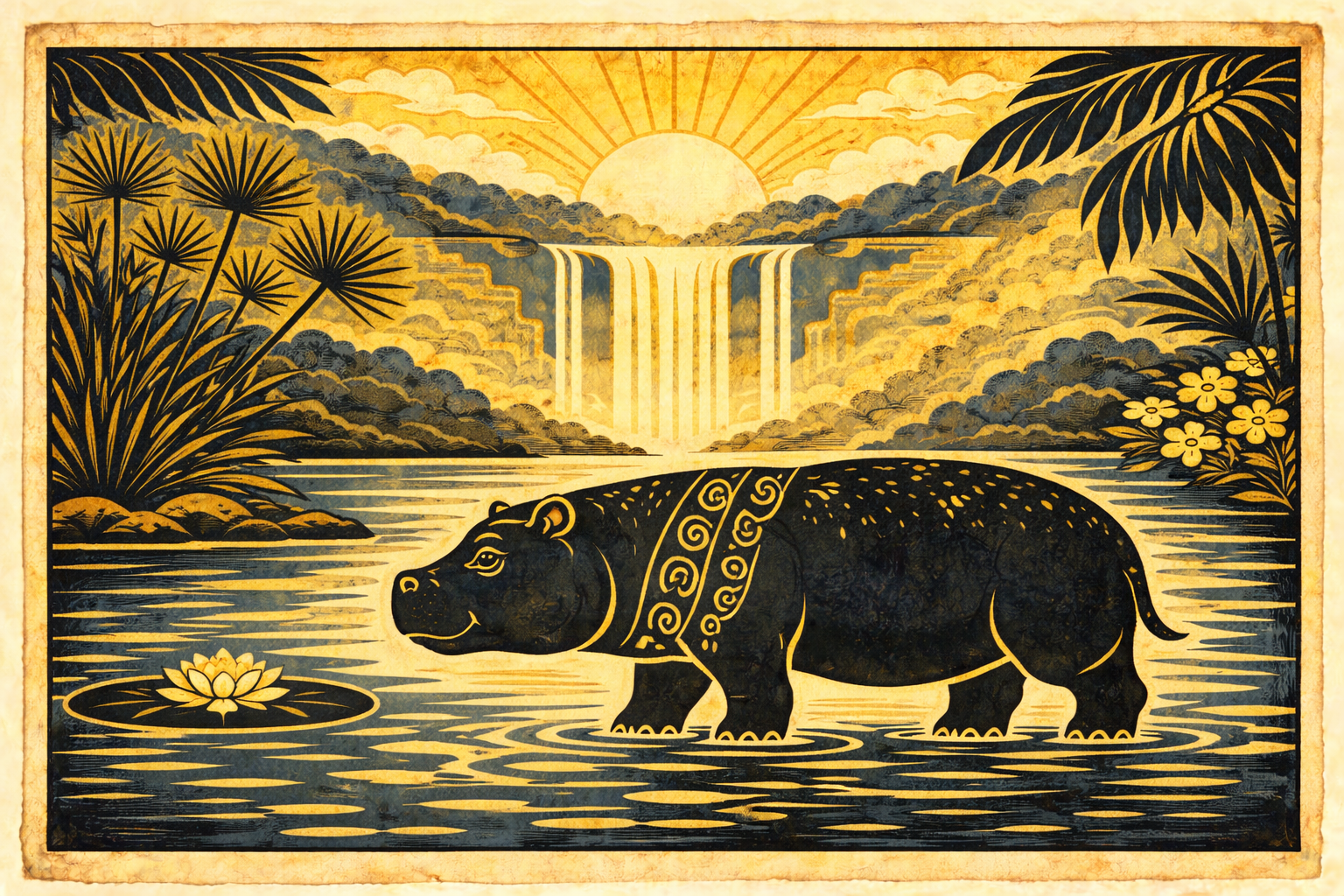
I first encountered the story in the most modern of places, which is to say on social media, where it appeared with the confidence of fact and the authority of an image. A black and white photograph from the mid-twentieth century showed a man standing beside a river framed by dense tropical vegetation, and the caption explained that he had rescued an orphaned hippopotamus calf, raised it, and years later had been killed and eaten by the same animal. The post carried the familiar tone of revelation, inviting outrage and wonder in equal measure.
Curiosity led me to search for a source, and the trail dissolved quickly into folklore. The story has no clear author and no documented event, yet it appears in multiple African oral traditions, where it functions as a cautionary tale about rivers, proximity, and the illusion of safety. The focus rests less on betrayal than on misunderstanding. The man mistakes familiarity for control, and the river remains what it always was.
The persistence of this story aligns with ecological reality. Hippopotamuses cause an estimated 500 human deaths across Africa each year, according to conservation and wildlife management sources, often by defending territory or reacting to sudden movement along riverbanks. They move faster than most people expect, they overturn small boats with ease, and they attack with extraordinary force when boundaries collapse. They do not hunt humans, yet they impose consequence with ruthless efficiency. A river rich in water, fish, and fertile soil also carries danger, and communities living beside such waters require stories that sharpen perception and reinforce distance.
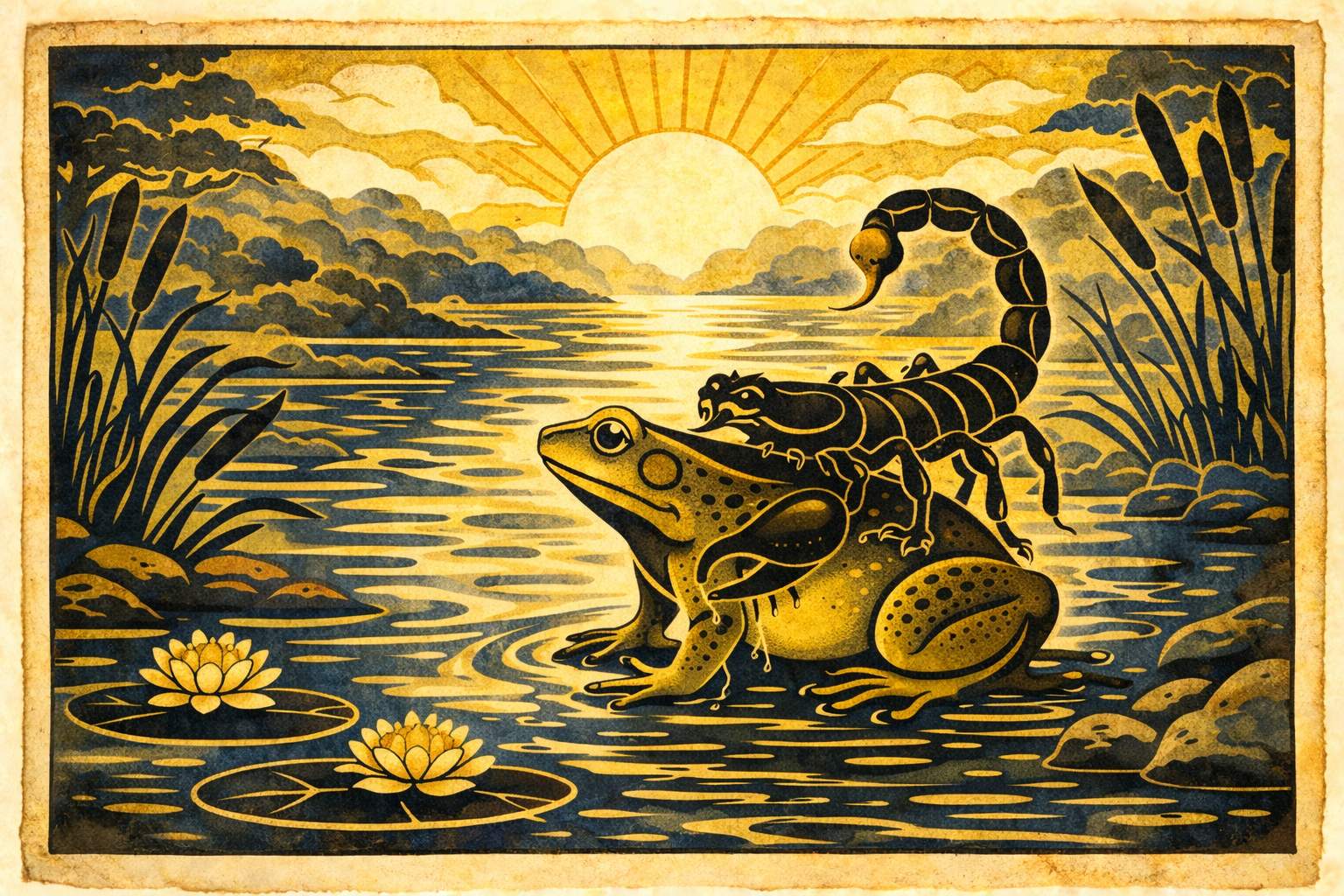
This tale brought to mind The Scorpion and the Frog, often associated with Middle Eastern storytelling traditions, though its origins remain diffuse. A scorpion asks a frog to carry him across a river, promising restraint in exchange for survival. Midstream, he stings his host, and as both begin to drown, he explains that the act reflects his nature. The moral does not condemn kindness. It clarifies expectation.
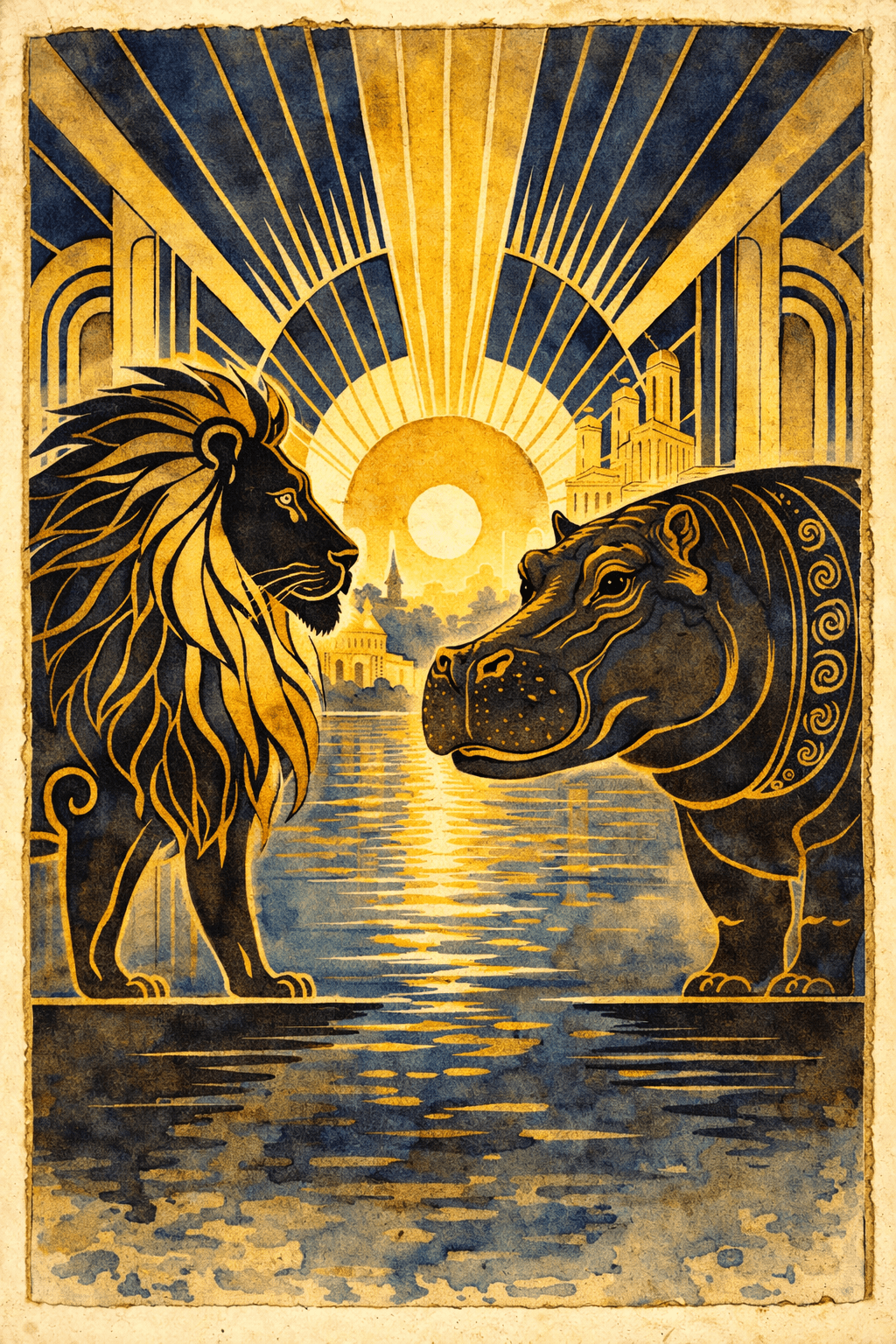
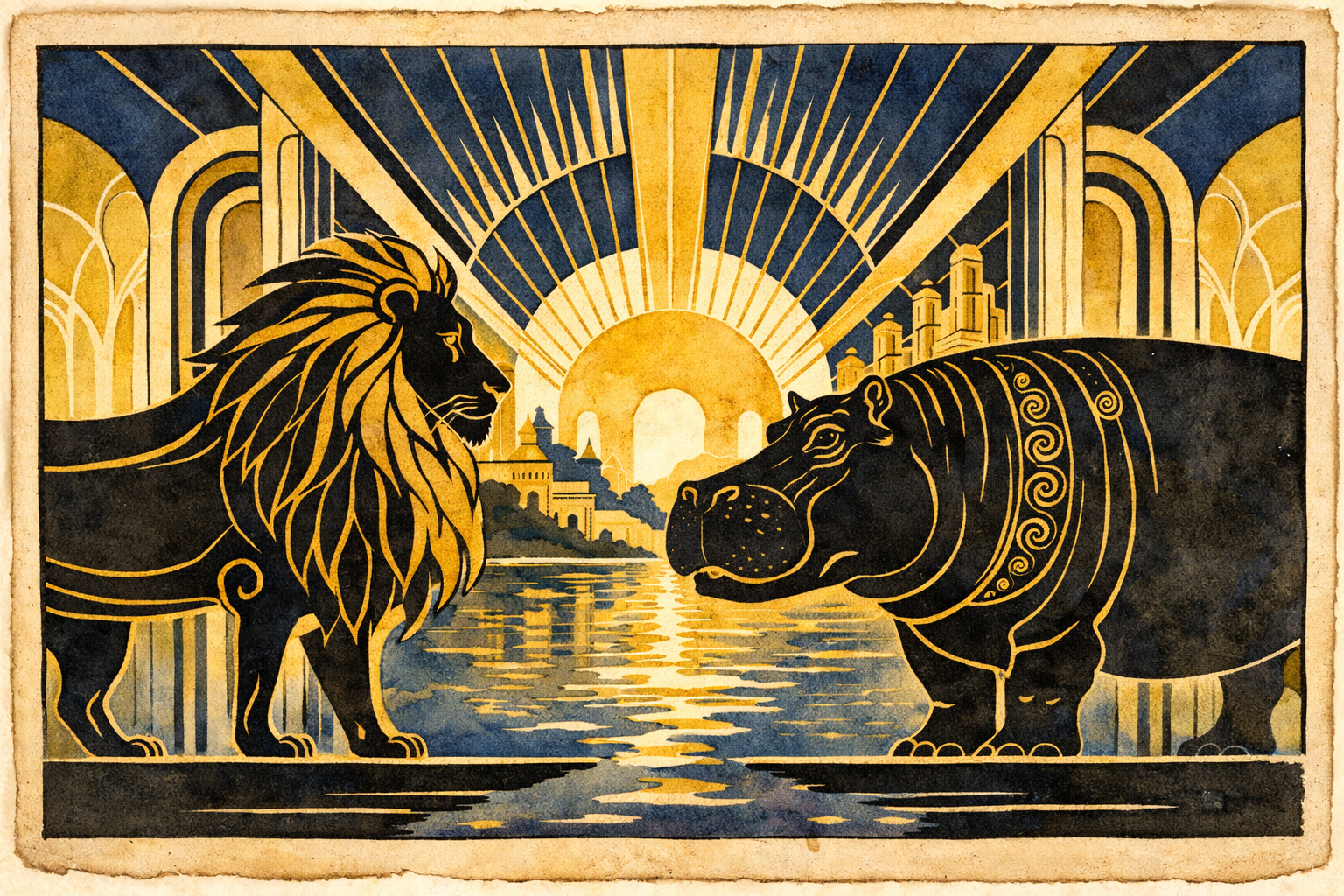
The contrast with Androcles and the Lion could not be sharper. In that ancient tale, preserved in written form by Aulus Gellius, a runaway slave removes a thorn from a lion’s paw. Years later, condemned in the Roman arena, he faces the same lion, who recognizes him and refuses to attack. The story celebrates loyalty, redemption, and the transformative power of compassion. It says almost nothing about lion behavior and almost everything about human hope.

Real lions operate according to very different logic. They evaluate risk constantly, avoid injury whenever possible, and retreat from unfamiliar humans unless hunger or circumstance shifts the balance. A wounded paw would weaken a hunter and threaten survival, yet no documented evidence suggests that a wild lion would later recognize and spare a specific human because of a single act of care. Memory in lions functions within prides and territories, not across symbolic debts.
A similar logic appears in the biblical account of Daniel in the lions’ den, where faith suspends violence and divine intervention reshapes nature. These narratives convert danger into moral theater and transform power into something negotiable.
Placed beside the hippo and the scorpion, a striking pattern emerges. Fables and myths often reveal more about the societies that shape them than about the animals they invoke. Communities living behind walls, buffered by engineering and surplus, imagine mercy in the wild and project ethical order onto unpredictable systems. Communities living in constant contact with ecological risk favor clarity over comfort and precision over hope.
This distinction aligns with the work of Joseph Campbell, who argued that myth encodes lived experience and offers models for navigating uncertainty. The lion becomes authority that remembers kindness. The hippo becomes nature that does not negotiate. The scorpion becomes instinct that cannot change. Each story organizes risk in a way that makes survival or stability more likely within a given environment.
The question that lingers feels less historical and more contemporary. Which stories now perform this function for us, and which allegories shape our expectations even when we no longer recognize them as such.
Mass media has not replaced folklore so much as accelerated it. Viral anecdotes about betrayal, resilience, institutional failure, and technological danger circulate at remarkable speed, and they often operate as cautionary tales without claiming that role. The hippo story itself thrives in this environment, reborn as a warning about trust and proximity in a world that feels both connected and unpredictable.
Two modern anxieties stand out. Artificial intelligence generates narratives of loss of control and autonomy, echoing older fears of tools that outgrow their makers. Climate change produces a different set of myths, some emphasizing inevitable catastrophe and others promising technological rescue. Both reveal deep concerns about agency, responsibility, and the limits of human power.
Modern societies rarely name these patterns as myth, yet their structure remains familiar. They simplify complexity into memorable images and emotionally resonant stories, and they circulate widely because they offer guidance in moments of uncertainty.
The hippo at the river, the scorpion midstream, and the lion in the arena endure because they compress biology, psychology, and social order into narrative form. Understanding instinct, whether animal or human, remains one of the most reliable strategies for navigating a complex world.
Further Reading
Classical and Folklore
Gellius, Aulus. Attic Nights. Translated by John C. Rolfe. Cambridge, MA: Harvard University Press, 1927–1952.
Aesop. Aesop’s Fables. Translated by Laura Gibbs. Oxford: Oxford University Press, 2002.
Uther, Hans-Jörg, ed. The Types of International Folktales: A Classification and Bibliography. Helsinki: Suomalainen Tiedeakatemia, 2004.
Animal Cognition and Behavior
Shettleworth, Sara J. Cognition, Evolution, and Behavior. 2nd ed. Oxford: Oxford University Press, 2010.
Tomasello, Michael. Becoming Human: A Theory of Ontogeny. Cambridge, MA: Harvard University Press, 2019.
Hippopotamuses
Eltringham, S. K. The Hippos: Natural History and Conservation. London: Academic Press, 1999.
Lewison, Rebecca, and William Oliver. “Hippopotamus amphibius.” The IUCN Red List of Threatened Species (2008).
Lions and Human Interaction
Packer, Craig, et al. “Ecological Change, Group Territoriality, and Population Dynamics in Serengeti Lions.” Science 307, no. 5708 (2005): 390–393.
Loveridge, Andrew J., et al. “The Landscape of Anthropogenic Mortality: Human Impact on African Lions.” Nature Ecology & Evolution 1 (2017): 0107.
 ERIC DORFMAN
Leave a comment