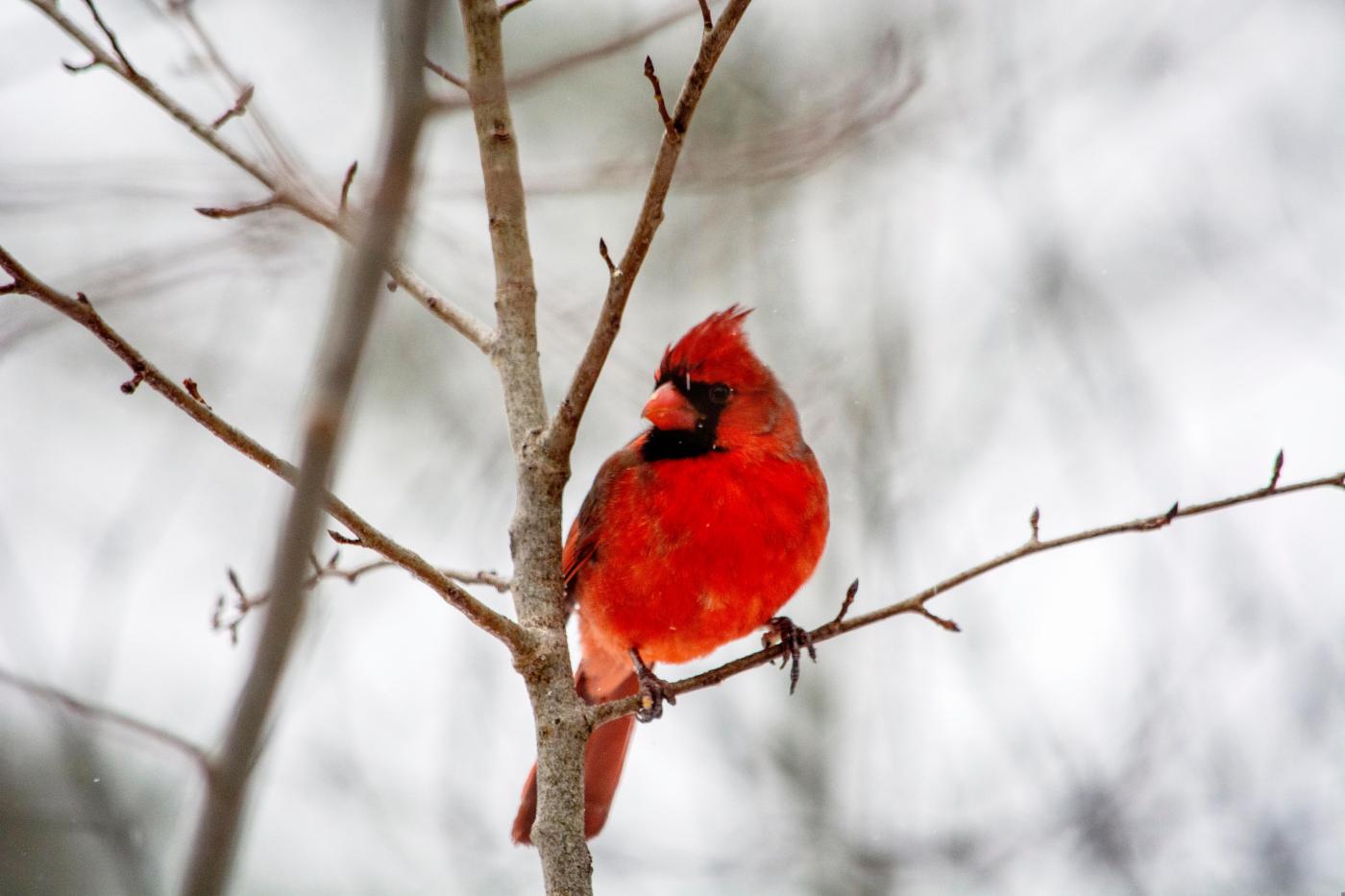
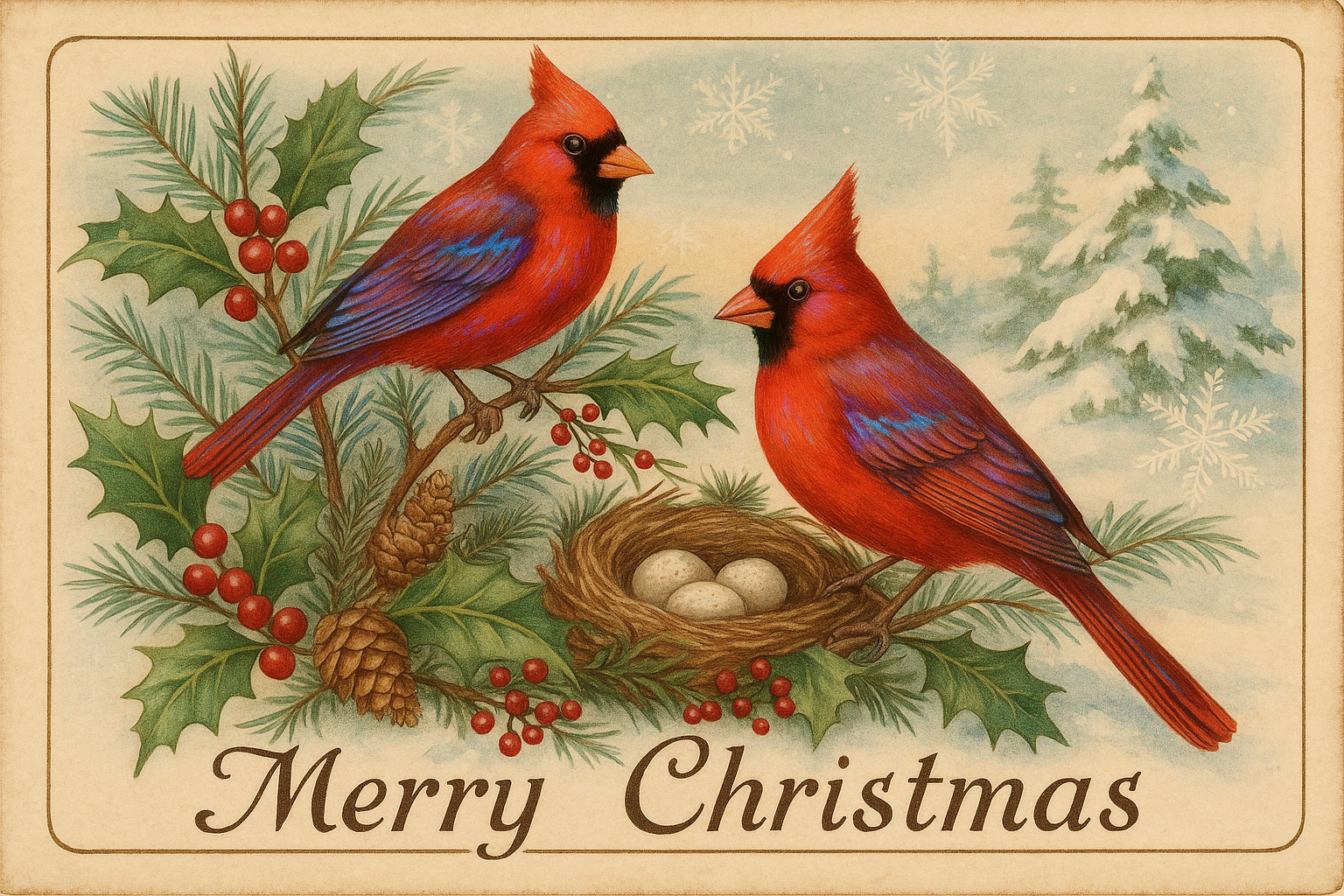
The cardinal on a Christmas card is so familiar it feels nearly obligatory. Snow, holly, a cutesy cottage, a bit of gilded script, an indiscriminate handful glitter, and a male Northern Cardinal Cardinalis cardinalis looks completely at home. The bird appears so visually perfect for the season that its place in winter iconography seems inevitable. The question I’ve been pondering this season is whether the bird shares even the slightest inkling of this visual drama. Does a cardinal know he is red? Does he know he stands out against the snow? Humans place meaning into the contrast, while the cardinal lives inside a completely different perceptual world.
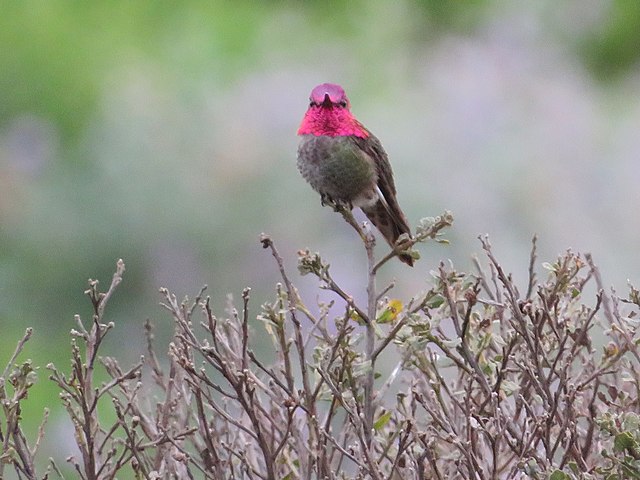
Asking this question isn’t as off the wall as it seems. For instance, male Anna’s hummingbird Calypte anna gleams a bright magenta color in the sun, the result of physical structures in their feathers. By adjusting their position in relation to the sun, they can turn their color on or off, switching between showy-but-risky bravado, and life-extending discretion. Structurally, cardinals are a bit different. Their red is a pigment, so they carry it with them wherever they go. More on this in a moment. The other question is whether cardinals, hummingbirds, or any other bird have a grasp at the aesthetic effect their visual display is making?
Animal awareness sits at the center of one of my earlier posts. Back in 2020, I wrote about a chicken was trained to play Puccini on an electric piano. In it, I explored the extent to which we could measure animals’ perception of meaning. Chickens and cardinals navigate reality with minds very unlike ours. They do not appear to form aesthetic categories but, instead, respond to information. Vision plays a central role in this process, and the sensory landscape a bird occupies differs from ours at a very fundamental level.

Humans see color with three types of cone cells. Birds use four. This additional cone grants access to ultraviolet wavelengths. A male cardinal also reflects ultraviolet light from his feathers, which means that another bird sees a far richer visual field than is possible for us. The iconic red crest becomes a layered signal of red, UV reflectance, and brightness. So, although we think the male cardinal looks intense in winter, it’s nothing compared to what’s perceived by his peers.
This alone answers half the question. A cardinal does not think of himself – or his competitors – as red, because to him, he’s not. He perceives how other cardinals react to him. His awareness sits not in self-recognition but in the feedback loop of social interaction.

Back to the nature of the cardinals’ color, which plays into the story. Unlike the structural color of birds like jays and buntings, the red in cardinals’ plumage contain carotenoids, which come from their diet (just like flamingos). These pigments convert into red ketocarotenoids through metabolic processes. The intensity of the color reveals a great deal about the male. A deeper red indicates strong immune function, low parasite load, and consistent access to quality food. It also hints at the competence of his territory. The winter feeder in your yard becomes an arena for evolutionary signals.
Females interpret these signals with precision (also see my post on the club-winged manakin), assessing males for their reproductive potential. A brightly colored male increases the odds that her offspring will inherit traits that improve their own success. Sons inherit signal strength. Daughters inherit the ability to select for it. The cycle repeats. Of course, no cardinal thinks in these terms – evolution handles the accounting very nicely.

This system does depend, however, on accurate perception, so avian visual processing becomes central. A female does not simply see “red.” She sees saturation, hue, brightness, and ultraviolet components. She also sees the feather condition itself. Structural integrity of the barbs affects the way light scatters. A worn male displays duller, rougher plumage. A healthy one advertises resilience. The sensory data form a complete profile that she evaluates with swift instinct.
This brings us back to the snowy landscape of Christmas cards. Humans cherish the contrast of red on white for emotional reasons. Snow acts as a blank canvas aesthetically, and the cardinal becomes the point of interest. The bird, however, lives in an entirely different version of that scene. Snow restricts available foraging. Cold increases energetic demands. The white backdrop does not read as a stage, but an environmental challenge. The male does not consider how his red appears against it. What only matters to him is that his signals travel clearly to the individuals that impact is life: his mate and potential rivals.
Yet their role in our cultural landscape remains real. We see them as symbols of warmth in the cold season. We appreciate how their color lifts the monotone of winter. We place them on cards and prints because they remain reliably present when many species retreat. They have become part of the imaginative architecture of winter.
The cardinal carries the pigments and feathers that evolution bestowed upon him, and that is enough to bring his world briefly into alignment with ours. We admire his color while he continues on his path, attentive to signals that matter to him alone. For a moment, two very different ways of seeing overlap, and the exchange feels quietly complete. As the year draws to its close, I value that kind of encounter. Christmas offers us a pause in which attention settles, the natural world remains present, and meaning emerges as a reward for observation. That feels like a good place to end the year.
Further Reading
Cuthill, I. C., Partridge, J. C., Bennett, A. T. D., Church, S. C., Hart, N. S., & Hunt, S. (2000).
Ultraviolet vision in birds.
Advances in the Study of Behavior, 29, 159–214.
https://doi.org/10.1016/S0065-3454(08)60105-9
Hill, G. E. (1991).
Plumage coloration is a sexually selected indicator of male quality.
Nature, 350, 337–339.
https://doi.org/10.1038/350337a0
McGraw, K. J., Hill, G. E., & Parker, R. S. (2005).
The physiological costs of being colourful: nutritional control of carotenoid utilization in a carotenoid-based plumage.
Animal Behaviour, 69(3), 653–660.
https://doi.org/10.1016/j.anbehav.2004.05.018
McGraw, K. J., & Hill, G. E. (2000).
Differential effects of endoparasitism on the expression of carotenoid- and melanin-based ornamental coloration.
Proceedings of the Royal Society B, 267(1452), 1525–1531.
https://doi.org/10.1098/rspb.2000.1174
Tschirren, B., Fitze, P. S., & Richner, H. (2003).
Sexual dimorphism in susceptibility to parasites and cell-mediated immunity in great tit nestlings
Journal of Animal Ecology, 72(5), 839–848.
https://doi.org/10.1046/j.1365-2656.2003.00754.x
 ERIC DORFMAN
Leave a comment